
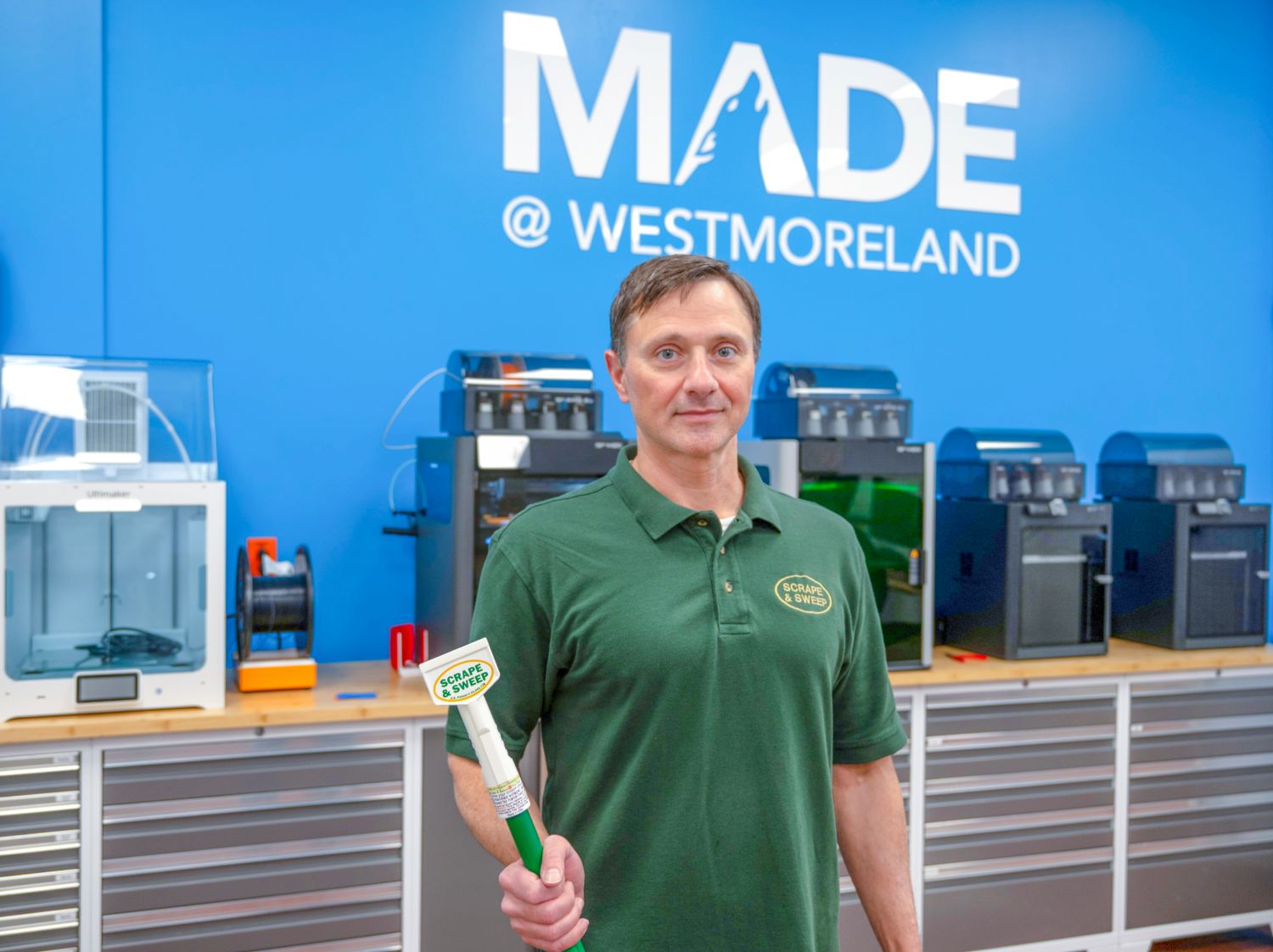
From Kitchen Floor to Patent: The Invention of the Scrape & Sweep
November 6, 2026A good invention often starts with a problem that needs to be solved.
For Westmoreland County Community College alumnus and MADE at Westmoreland member Keith Dvorchak, that problem was dried-up applesauce and crisped rice cereal on his kitchen floor.
When Keith’s daughter was an infant learning to feed herself, it wasn’t unusual for some of her food to end up on the floor. If the mess went unnoticed for a while, Keith found himself kneeling on the floor, using a butter knife to scrape away dried food before sweeping and mopping.
There had to be an easier way.
One winter morning, Keith tried using a plastic ice scraper instead. He quickly discovered that it worked much better than a knife. The plastic blade could remove dried food from floors, tables, countertops and other surfaces without scratching them.
His next thought was simple: Why not attach the scraper to a broom handle?
Keith taped the ice scraper to the end of a broom, allowing him to scrape the floor without having to kneel down. But the solution created another problem, as the scraper was difficult to use on other surfaces.
That led to the first version of what would eventually become the Scrape & Sweep.
Keith shaped a piece of PVC pipe into a tubular handle that could be attached to the scraper with screws. The attachment could slide onto a broom handle for long-handled cleaning and then be removed for use as a handheld tool.
That original prototype has come a long way.
A 2013 Westmoreland County Community College graduate with a degree in Business Management, Keith learned about MADE at Westmoreland through an email to alumni announcing its opening. MADE, the college’s makerspace and advanced manufacturing facility, gives students, entrepreneurs and community members access to equipment, technology and training to design, create and prototype products. Since becoming a member, Keith has used MADE’s technology and equipment to continue refining his invention.
“I had been wanting to insource product development work from other entrepreneurs but just had no time or money to spend on the training and equipment I needed. Through the MADE makerspace, I’ve gotten training and equipment that has allowed me to speed up the development of my invention,” Keith said.
One of the biggest changes has been moving from the original PVC prototype to 3D-printed designs. At MADE, Keith learned to use Tinkercad to create streamlined 3D models of the Scrape & Sweep, allowing him to experiment with different designs and test them in the real world.
He has now gone through five versions of the product.
Keith currently 3D prints the Scrape & Sweep using PLA+ material and continues to make improvements based on feedback and testing. The finished product allows users to turn a broom or mop handle into a long-handled scraper, while also functioning as a handheld cleaning tool.
It can be used to remove dried food, glue, stickers, dirt and ice from surfaces including floors, windows, countertops and tables.
“Keith is a great example of what can happen when an inventor has access to the right resources,” said Michael Rottman, MADE Director. “He came to MADE with a working concept, and we've been able to help him take that design further through 3D modeling, prototyping and testing. Having the ability to quickly make a new version, try it out and make changes is a huge advantage for an inventor. It’s been great to see Keith continue to refine the Scrape & Sweep and turn an idea born out of everyday life into a real product.”
Keith received a patent for the Scrape & Sweep in 2019 after applying for one in 2016. Today, he sells the product on eBay.
But he isn't finished yet.
One of the challenges with 3D printing the Scrape & Sweep is the amount of time required to produce each unit. Keith’s next goal is to transition to injection molding, which would allow him to produce the product more efficiently and in larger quantities.
What began with a child dropping applesauce on the kitchen floor has evolved into a patented product, five generations of prototypes and a business opportunity, all built around one simple question: how can cleaning be made a little easier?
Interested in trying the Scrape & Sweep? Visit scrapeandsweep.com to learn more about Keith’s invention and find a link to purchase the product.